Commercial EPOS System Used at Greggs

The Commercial EPOS System Used at Greggs: What’s Actually Powering That Till
You’ve queued for a sausage roll a hundred times and never once wondered about the screen the server’s tapping. I did wonder — so I went digging. Here’s the full stack, from the fanless touchscreen on the counter to the loyalty engine that decides whether you’ve earned a free coffee.
The short version
Greggs doesn’t buy its tills off the shelf. It runs its own software on J2 Retail Systems hardware — fanless and solid-state, built for a hot, floury bakery — wired into Eagle Eye’s AIR loyalty platform and a Cisco Meraki network. The app now gets scanned on 31% of company-managed transactions. New for 2026: self-service Greggs Express units and SAP S/4HANA moving through retail operations.
The till itself: built for flour, steam and oven heat
Here’s the thing most people get wrong. Greggs didn’t ring up a POS company and buy a thousand tills. Back in 2006 it partnered with J2 Retail Systems to build something specific to a bakery — and it’s been iterating on that ever since.
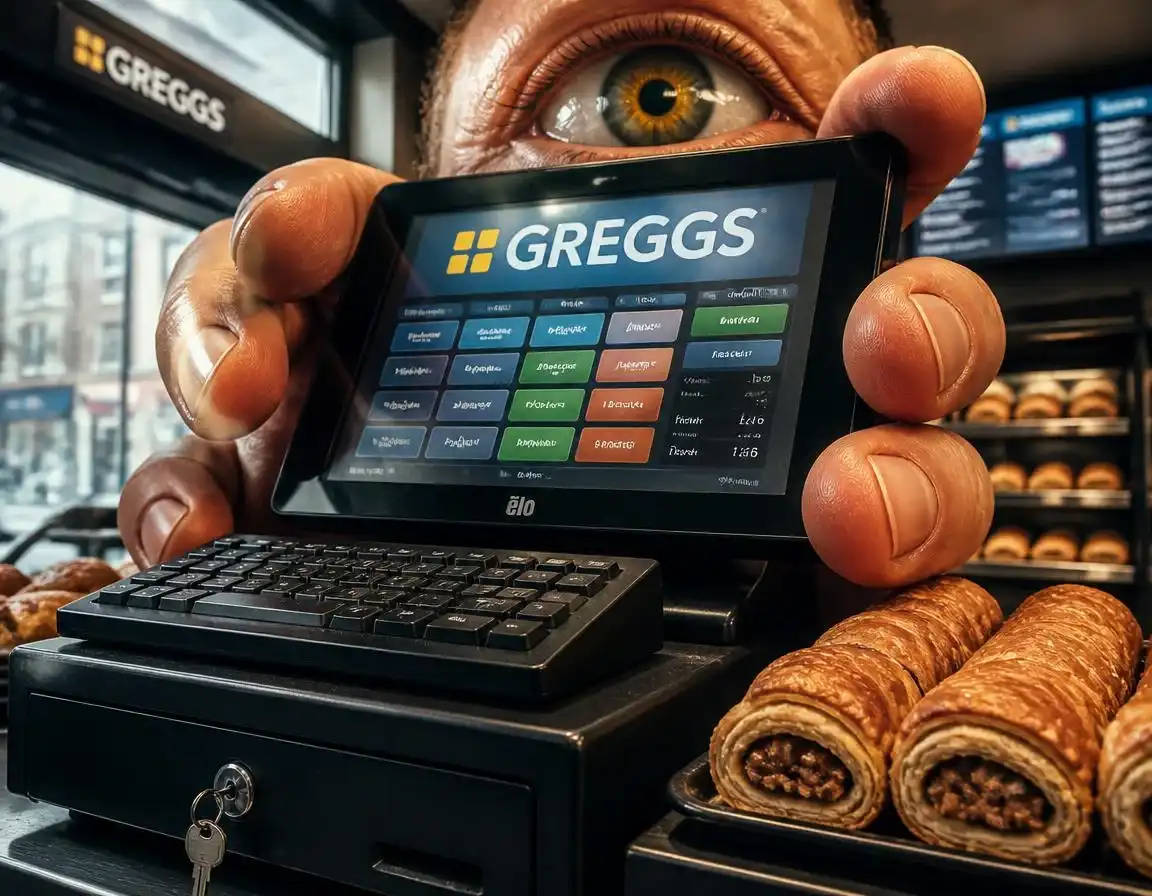
The design choices tell you everything about the environment. No cooling fan, because a fan in a bakery is just a very efficient flour-sucking machine. No spinning hard drive — solid-state storage instead, so there’s nothing mechanical to shake loose. The whole lot is pole-mounted, which frees up counter space that would otherwise be a till footprint. J2 called the approach “all-in-the-head”: processor, ports and screen in one unit, cabling hidden down the pole.
By 2011 there were roughly 4,000 of these terminals running across about 1,570 shops, including the J2 615 — which J2 claimed as the first EPOS terminal shipping with SSD storage as standard. Greggs has historically looked for five to seven years out of a till before replacing it, which is a long service life in retail and tells you the fanless, no-moving-parts thinking paid off.
How the Greggs app actually talks to the till
This is the clever part, and it’s the bit that’s changed most since the app launched as “Greggs Rewards” in 2014.
The loyalty engine is Eagle Eye’s AIR platform — Eagle Eye is a Guildford-based SaaS company that also handles loyalty for Tesco, Asda and Sainsbury’s, so this is serious infrastructure rather than a bolt-on. Greggs renewed a multi-year contract with them, so this isn’t going anywhere soon.
When you tap your phone at the card terminal, AIR checks your basket, records your stamps, applies whatever personalised offer you’ve been sent, and the payment goes through — in one interaction. That’s the difference between a loyalty scheme that slows the queue down and one that doesn’t. Anyone who remembers fumbling for a paper loyalty card knows which one Greggs was aiming for.
And it’s working. In the first half of 2026 the app was scanned on 31% of company-managed shop transactions, up from 25.7% in the same period a year earlier. That’s roughly one in three people at the counter handing Greggs a first-party record of exactly what they buy and when — data most supermarkets would happily pay for.
Share of company-managed transactions scanned in the Greggs app
Full-year figures for 2024 and 2025; H1 for 2026. Source: Greggs PLC preliminary and interim results.If you want to get more out of that tap yourself, my guides to how the AppStamp system works and the app hacks worth knowing go deeper into the rewards side of it.
Three price tiers, one till system
Here’s an EPOS detail nobody talks about, and it’s the one that affects what you actually pay.
The same till software runs more than one price list. Broadly, Greggs prices to three tiers: standard high street, city and London shops, and franchised sites — the airports, motorway services and station units run by partners rather than by Greggs itself. Scan a sausage roll in Sunderland and in a Heathrow departure lounge and the till returns two different numbers.
That’s not a glitch, it’s a configuration. Franchise partners run their own businesses and set their own prices, which is exactly why airport Greggs stings. The tiering is also why the new pricing and promotions till software being deployed through 2026 matters more than it sounds — managing three price structures plus app offers plus meal deals across nearly 2,800 shops is genuinely fiddly, and doing it badly means wrong prices on shelves.
I’ve broken the actual numbers down in the London vs rest of UK price comparison and, for the eye-watering end of it, airport prices at Gatwick and Heathrow.
The network holding the whole thing up
A till is only as good as its connection. In 2022 Greggs signed with Daisy Corporate Services — a technology partner since 2008 — to roll out a Cisco Meraki SD-WAN across more than 2,100 shops, part of what Greggs called its “Store of the Future” programme.
In plain English: every shop gets managed networking, Wi-Fi and 4G/5G backup, all centrally controlled. That matters because the till isn’t just taking card payments any more. It’s checking loyalty baskets in real time, pulling delivery orders in from Just Eat and Uber Eats, and pushing sales data back to head office. Lose connectivity in a food-on-the-go shop at lunchtime and you lose the lunchtime.
Delivery is now a meaningful chunk of that traffic — around three-quarters of company-managed shops accept orders through Just Eat and Uber Eats, and delivery made up 6.8% of company-managed shop sales in 2025. If you order that way, my comparison of Just Eat vs Uber Eats vs Deliveroo for Greggs is worth a look before you pay the markup, and Click and Collect routes straight through the same in-shop system.
SAP S/4HANA, and the deeply boring bit that matters
Behind every transaction sits an ERP system, and Greggs has been on SAP since 2014. The current job is migrating to SAP S/4HANA — finance and procurement went first, with manufacturing, logistics and retail operations following through 2026.
Why should you care? Because it’s the difference between a bakery that guesses and one that knows. Every scan feeds demand forecasting, which decides how many steak bakes get baked in which shop at what time. Get it right and there are bakes on the shelf at 2pm. Get it wrong and you’re either sold out or binning stock — and I’ve written about what happens to unsold Greggs food when that maths doesn’t land.
The wider stack includes Power BI and Oracle for reporting, SAP Ariba for procurement and SAP SuccessFactors for HR — the system that handles team member pay and scheduling for a workforce of more than 33,000.
Self-service and the arrival of Greggs Express
This is the genuinely new development for 2026, and it changes the EPOS conversation completely.
In May 2026, Greggs opened its first Greggs Express unit — a compact, entirely self-service format — at a Motor Fuel Group petrol forecourt just outside Glasgow Airport. No counter, no server, no traditional till. You help yourself to bakes and sweet treats, pour your own Fairtrade coffee, and check yourself out. Greggs plans around ten of these trial units in 2026, mostly at travel hubs on MFG sites.
It follows self-service ordering screens that Greggs trialled in shops during 2025, and sits alongside the smaller “bitesize Greggs” format now open in a handful of locations including Cheshire Oaks and a couple of railway stations. Different problem, same answer: get people served faster in places where a full shop doesn’t fit.
There’s more coming too: Greggs has talked about vending machines, and an in-shop digital assistant to help staff with daily decisions is being piloted. For the longer view on where this is heading, see my piece on Greggs future technology.
The full stack at a glance
| Layer | Who provides it | What it does | Status 2026 |
|---|---|---|---|
| Till hardware | J2 Retail Systems | Fanless, solid-state, pole-mounted touchscreen terminals | Active |
| Till software | Greggs, in-house | Pricing tiers, promotions, transactions | Updating |
| Loyalty & offers | Eagle Eye AIR | Real-time basket checks, stamps, personalised offers | Active |
| Payments | NFC card terminals | Contactless, mobile wallet, app tap | Active |
| Network | Daisy / Cisco Meraki | SD-WAN, Wi-Fi, 4G/5G failover across 2,100+ shops | Active |
| ERP | SAP S/4HANA | Finance, procurement, supply chain, forecasting | Migrating |
| Reporting | Power BI / Oracle | Sales analytics and operational dashboards | Active |
| Delivery | Just Eat & Uber Eats | Third-party orders into the in-shop system | Active |
| Self-service | Greggs Express (with MFG) | Unstaffed self-checkout format at travel hubs | Trial |
Could a small bakery copy any of this?
Parts of it, yes — and this is where I think the Greggs setup is genuinely instructive rather than just interesting.
You can’t buy the Greggs stack. The till software is in-house, the J2 hardware was co-developed, and an Eagle Eye contract is priced for Tesco, not for a two-shop bakery. But the principles transfer cleanly:
- Buy hardware for the room it lives in. Fanless and sealed beats sleek and fragile when there’s flour in the air.
- Make loyalty part of the payment, not a separate step. Anything that adds seconds to a queue at 12:45 will quietly get skipped by staff.
- Own your sales data. Greggs’ forecasting advantage comes from knowing what sold where and when. That’s a report, not a budget.
- Sort the connection before the clever stuff. Card payments failing at lunchtime costs more than any feature gains you.
Bakery-specific EPOS platforms like ICRTouch, Cybake and EPOS Now cover most of this at a scale that makes sense for independents. The gap isn’t really software any more — it’s whether you use the data the till’s already collecting.
Frequently asked questions
What EPOS system does Greggs use in the UK?
Greggs doesn’t use an off-the-shelf till. It runs its own software on touchscreen hardware built with J2 Retail Systems, a partnership that goes back to 2006. That till talks to Eagle Eye’s AIR platform for loyalty and offers, sits on a Cisco Meraki network supplied through Daisy, and reports into SAP S/4HANA behind the scenes. New till software for pricing and promotions is rolling out across the estate through 2026.
How does the Greggs app talk to the till?
You tap your phone on the card terminal and Eagle Eye’s AIR platform checks your basket in real time, adds your stamps, applies any personalised offer and takes the payment — all in one tap. It’s quick because the loyalty check and the payment happen together rather than one after the other. In the first half of 2026 the app was scanned on 31% of company-managed shop transactions, up from 25.7% a year earlier.
Why do Greggs prices differ between shops on the same till system?
Because the till software runs more than one price list. Greggs prices to roughly three tiers — standard high street, city and London shops, and franchised sites like airports and motorway services — so the same sausage roll scans at a different price depending on where you’re standing. Franchised shops are run by partners who set their own prices, which is why airport Greggs is dearer. The improved pricing and promotions software landing in 2026 is aimed squarely at managing this more cleanly.