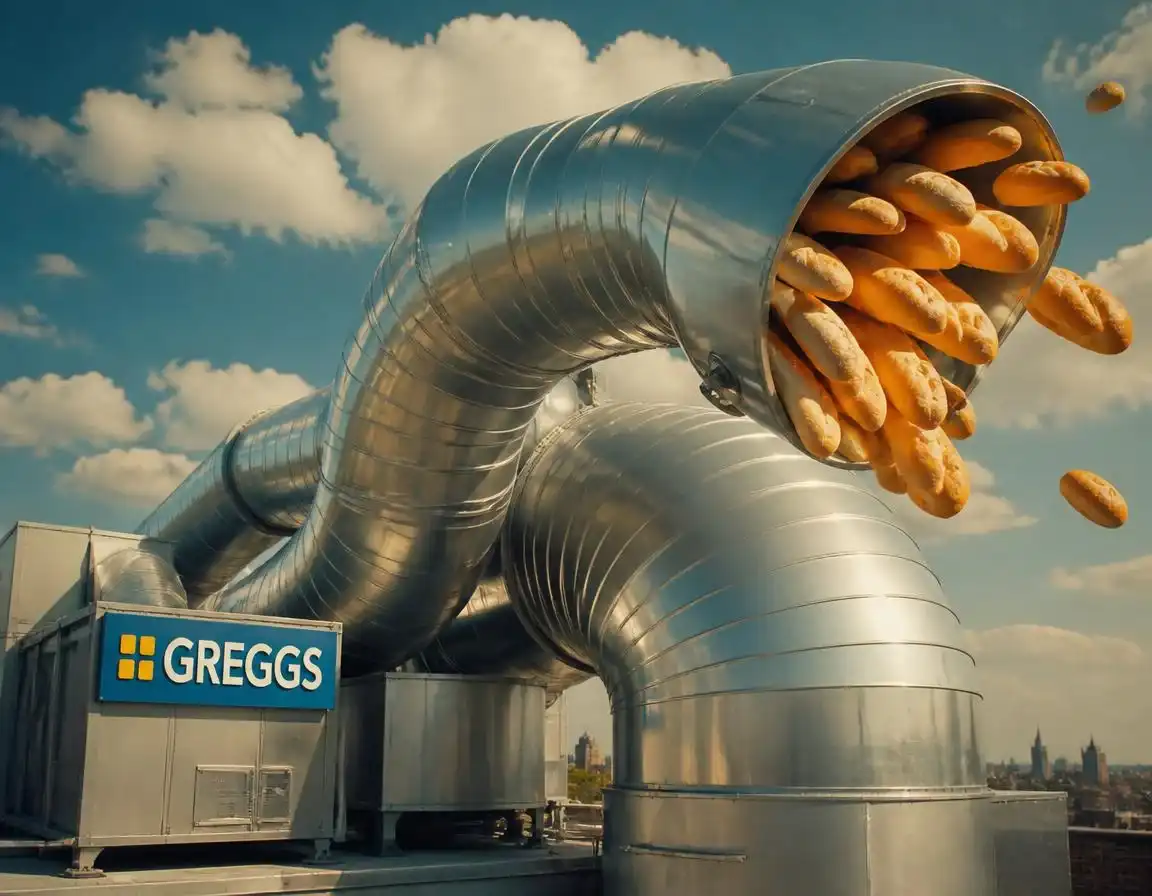
Commercial Ventilation SystemUsed at Greggs UK

Commercial Ventilation System
Used at Greggs UK
Look up next time you’re queuing for a sausage roll and you’ll spot it: a stainless-steel canopy quietly doing one of the hardest jobs in the shop. Here’s what actually goes into keeping a fryer-heavy, high-street bakery kitchen safe, legal and breathable — and what it means if you’re specifying something similar yourself.
📝 The short version
Greggs hasn’t confirmed exactly what ventilation kit sits above the fryers in its 2,700+ UK stores, but the format gives it away: expect wall-mounted stainless steel canopies with baffle filters, DW172-compliant ductwork and make-up air, cleaned to TR19 standards every quarter or so. Newer Eco-format stores add heat pump air conditioning and demand-controlled ventilation to cut energy use. If you’re specifying a similar system yourself, the regs (DW172, Part F, TR19, BS 6173) matter more than any particular brand.
Let’s be honest — when most of us walk into a Greggs, we’re not staring at the ceiling. We’re eyeing up the sausage rolls. But look up, and there’s a stainless-steel canopy quietly doing one of the most important jobs in that kitchen. Without it, your favourite bakery would be hot, smoky, greasy and, frankly, a fire risk.
I’ve dug into exactly what goes into the commercial kitchen ventilation system Greggs UK stores need to run legally, across an estate of nearly 2,800 shops. Whether you’re a catering manager, a facilities contractor, or just someone who’s always wondered what’s happening behind that counter, this is written for you.
One thing worth saying up front: Greggs hasn’t published the make or model of ventilation kit it uses, and I couldn’t find a public contract, planning document or press release that names one. So where I’m giving you an informed estimate rather than a confirmed fact, I’ve said so — no guessing dressed up as certainty.
Why Kitchen Ventilation Matters in a Bakery Like Greggs
Greggs isn’t a bakery in the old-fashioned sense any more. Every store runs a genuinely varied cooking operation all day, and each process throws up its own ventilation problem.
During the breakfast rush, ovens are finishing off sausage rolls and bakes while fryers run hash browns at around 175–185°C. From mid-morning onwards, the same fryers are turning out Southern Fried Potato Wedges, Chicken Goujons and Spicy BBQ Chicken Bites. Add a busy coffee machine pumping out steam, hot-holding cabinets, and a dishwasher running constantly, and that’s a lot of heat, moisture and grease-laden air that has to go somewhere.
Skip proper extraction and you don’t just get an uncomfortable kitchen — you get grease building up in ductwork (a genuine fire risk), poor air quality for staff, and a shop that falls foul of UK health, safety and planning rules.
Heat & Thermal Convection
Ovens and fryers running at 170–200°C throw off sustained heat that needs continuous extraction to keep the kitchen bearable to work in.
Grease-Laden Vapour
Deep frying releases fine grease particles into the air. Left unmanaged, they coat ductwork and become a serious fire hazard — regular filtration and cleaning are non-negotiable.
Steam & Moisture
Coffee machines and dishwashers generate moisture that causes condensation and mould without effective extraction.
Cooking Odours
Stores in mixed-use buildings have to control cooking smells reaching neighbours, under local Environmental Health rules.
What Commercial Ventilation System Does Greggs Use?
Here’s the honest answer: Greggs plc hasn’t confirmed the exact brand or model of ventilation kit fitted across its estate, and equipment contracts of this kind are rarely made public for any large retail chain. What we can do is work out the specification with a fair degree of confidence, based on the store format, the menu, and how UK commercial kitchens of this type are built.
Most Greggs stores are converted retail units or purpose-built high-street shops where space is tight. That rules out island canopies (the big central hoods you’d see in a hotel kitchen) for all but the largest sites. Instead, the near-certain setup is a wall-mounted stainless-steel extraction canopy positioned directly above the fryer and oven line — the standard, space-efficient choice for a compact food-to-go kitchen.
🟢 The likely specification
Based on the store layout, the menu and standard UK commercial kitchen practice, a typical Greggs store almost certainly runs a wall-mounted extraction canopy with stainless-steel baffle filters over the fryers and ovens, connected to grease-rated ductwork discharging above roof level, with make-up air supplied to keep the kitchen at neutral pressure. The kind of equipment that fits this brief is well established in the UK trade — manufacturers such as Halton, a pioneer of demand-controlled kitchen ventilation, and CaptiveAire both build wall-mounted, DW172-style canopy systems for exactly this kind of compact food-to-go kitchen, and UK specialists such as Corsair Engineering fabricate bespoke stainless canopies to the same spec. That’s the ballpark Greggs’ stores are almost certainly operating in — a reasonable estimate, not a confirmed fact.
Newer Eco-format stores go further. Greggs’ first Eco-Shop opened in Northampton in 2022, and its Eco Drive-Thru in Winchester (opened June 2025) added heat pump air conditioning and overdoor heater systems working together to balance air temperature, plus a heat recovery system that reuses warm air from refrigeration extraction. These features are being tested for wider rollout as they prove themselves.
Whatever the exact kit, every Greggs store must comply with DW172, Approved Document F (Volume 2) and TR19 Grease cleaning requirements by law — that part isn’t in doubt.
For context on the equipment actually generating all that heat and grease, see our guides to the commercial deep fryers used at Greggs and the bake-off ovens behind the counter.
Key Components of a Commercial Kitchen Ventilation System
An extraction canopy is only one part of the full system. Here’s what a compliant setup — like the one a Greggs-format kitchen would need — actually consists of.
A typical wall-mounted commercial kitchen extraction system — the kind used in compact UK bakery and food-to-go stores, designed to DW172 and Approved Document F standards
| Component | Function | Material / Standard | Required? |
|---|---|---|---|
| Extraction Canopy Hood | Collects heat, steam and grease vapour above cooking equipment | Stainless steel | Mandatory |
| Baffle Filters | Trap grease particles before air enters the ductwork | Stainless steel, removable | Mandatory |
| Grease Collection Tray | Captures liquid grease draining from the baffle filters | Stainless steel channel | Mandatory |
| Extract Ductwork | Routes extracted air from the canopy to an external discharge point | DW144-spec steel, fire-rated | Mandatory |
| Extract Fan | Creates the negative pressure that pulls air through the system | In-duct or roof-mounted | Mandatory |
| Make-Up Air Supply | Replaces extracted air to keep the kitchen at neutral pressure | Fresh air intake, tempered | Mandatory |
| Gas Interlock (AIV) | Cuts the gas supply automatically if the extraction fan fails | BS 6173 compliant | If gas appliances present |
| Odour Control | Removes cooking odours before external discharge | Carbon filter stage | Planning-dependent |
| Demand-Controlled Ventilation (DCKV) | Adjusts fan speed automatically based on real-time cooking activity | Optical / thermal sensors | Optional, energy-saving |
Types of Extraction Canopy Used by UK Bakery Chains
Not every extraction canopy is built the same way. The right choice depends on the kitchen layout, the equipment in use, and the ceiling height available. Here’s how the main options compare for a compact food-to-go format like Greggs’.
| Canopy Type | Configuration | Best Suited To | Typical in Greggs Format? |
|---|---|---|---|
| Wall-Mounted Canopies | |||
| Wall-Mounted Extract Only | Against rear wall, extract duct vertical | Compact high-street stores, fast-casual | Most likely |
| Wall-Mounted with Supply Plenum | Canopy contains both extract and fresh-air supply | Stores needing integrated make-up air | Plausible in newer formats |
| Other Commercial Types | |||
| Island Canopy | Central ceiling-hung, capture from all sides | Large kitchens with a central cook line | Unlikely — space constraint |
| Condense Canopy | Above dishwashers and steam equipment | High-steam prep areas | Possible near dishwasher area |
| Recirculation (Ductless) | Internal carbon/grease filter, no external duct | Sites where ducting to atmosphere isn’t possible | Rare for continuous frying |
UK Regulations Every Greggs Store Must Follow
Running a commercial kitchen ventilation system in the UK isn’t a grey area. There’s a clear framework every Greggs store — and every other commercial kitchen in Britain — has to work within. Here’s where things stand as of September 2026.
📘 DW172 — BESA Specification
BESA’s Specification for Kitchen Ventilation Systems, first issued as DW/171 in 1999 and rebadged DW172 in 2005. The current second edition dates from October 2018 and covers airflow calculations, canopy design, ductwork and grease management, including a section on demand-controlled ventilation. It’s guidance rather than law, but Building Control, Environmental Health and insurers all treat it as the benchmark.
🏛️ Approved Document F, Volume 2
The Building Regulations guidance for ventilation in non-domestic buildings, including commercial kitchens. The current edition dates from December 2021 and has been in force since 15 June 2022, requiring adequate extract rates and a minimum outdoor air supply. Note: the widely-discussed 2026 update to Approved Document F applies to Volume 1 (dwellings) only — it doesn’t change the rules for kitchens.
🔥 TR19 Grease — Fire Safety
BESA’s standalone specification (since 2019) for cleaning grease-laden kitchen ductwork. For a high-use operation like Greggs, frying for most of the trading day, cleaning every one to three months is the typical benchmark. Insurers frequently require up-to-date TR19 certificates as a condition of cover.
⚗️ BS 6173 — Gas Interlock
Where gas cooking appliances are fitted, BS 6173 requires an automatic gas interlock (or air interlock valve) that shuts off the gas supply if the extraction fan stops. Many compact Greggs stores are likely electric-only, in which case this doesn’t apply — but it becomes mandatory the moment gas equipment is introduced.
🌿 EMAQ+ — Odour & Planning
The EMAQ+ guidance document, “Control of Odour and Noise from Kitchen Exhaust Systems,” is what local authorities work from when assessing planning applications for a new store or kitchen change. It can require carbon filtration or a specific discharge height, particularly near residential premises.
🏥 Health & Safety at Work Act 1974
Underneath all the technical standards, the HSWA places a general duty on every employer — including Greggs, with a workforce of around 33,000 people — to provide a safe working environment. Poor kitchen ventilation exposing staff to excessive heat or grease-laden air is a breach of that duty.
Greggs’ Eco Stores & Demand-Controlled Ventilation
One of the more interesting developments in how Greggs approaches kitchen ventilation is its Eco-Shop programme. The first Eco-Shop opened in Northampton in July 2022, and by the end of 2024 elements from that format had been rolled out to around 27% of the estate, with Greggs targeting 30% by the end of 2025, according to its latest published sustainability report.
The Eco Drive-Thru that opened in Winchester in June 2025 took things further, adding heat pump air conditioning and overdoor heater systems that work together to balance store temperature, plus a heat recovery system that reuses warm air from refrigeration extraction to help heat the building. That’s a practical example of the kind of thinking behind demand-controlled kitchen ventilation (DCKV) — technology that adjusts extraction fan speed to match actual cooking activity, rather than running flat out all day.
DCKV isn’t Greggs-specific — it’s an established energy-saving technology across the UK hospitality sector, recognised by the US EPA’s Energy Star programme and increasingly common in UK kitchen refits. Typical fan energy savings sit in the region of 30–60%, depending on the kitchen’s cooking pattern and how the system is installed, with the largest gains during quiet periods rather than peak service.
TR19 Grease Cleaning Frequency, by Kitchen Usage
How often BESA’s TR19 Grease guidance says extract ductwork should be cleaned — frequency is driven by cooking hours, not a flat rule. Source: BESA TR19 Grease guidance.
A Greggs-style store, frying for most of its opening hours, sits firmly in the “heavy use” band. For more on the format changes behind this, see our guides to Greggs Eco Shop locations and Greggs’ compact Bitesize stores.
Sourcing & Specialists: Who Actually Builds This Kit
If you’re specifying or maintaining a similar system for your own café, bakery or food-to-go unit, it helps to know who does what in this market. None of the names below are confirmed Greggs suppliers — I couldn’t find a public record of who Greggs actually contracts with — but they’re genuine, established players in UK commercial kitchen ventilation, and a sensible starting point if you’re sourcing similar kit.
| Type of Specialist | What They Do | Example UK Names | Best For |
|---|---|---|---|
| DCKV / Canopy Equipment Manufacturers | Design and manufacture demand-controlled ventilation hardware and canopy systems | Halton, CaptiveAire | New-build or major refit programmes |
| Bespoke Canopy Fabricators | Design and fit stainless canopies to a site-specific DW172 spec | Corsair Engineering, eCanopy | Independent sites, compact retrofits |
| TR19 / DW172 Compliance & Cleaning | Duct cleaning, grease testing and compliance certification | BESA/VHR-registered contractors such as Fan Services Ltd | Ongoing compliance across a multi-site estate |
| M&E Consultants | DW172 system design and Approved Document F calculations | BESA-member building services engineers | Larger new-build or refurbishment projects |
For an estate the size of Greggs’ — pushing towards 3,000 stores — the sensible approach is a preferred-contractor framework agreed centrally, with local specialists fitting a nationally specified template store by store. That keeps things consistent, compliant, and predictable to cost.
The takeaway for any food business trying to match that standard: get the system properly designed and commissioned to DW172 up front, keep TR19 cleaning records up to date, and look seriously at demand-controlled ventilation if you’re running more than one site — the energy savings add up fast.
Frequently Asked Questions
The questions I get asked most about Greggs’ kitchen ventilation — and commercial kitchen extraction more generally.
What ventilation system does Greggs use in its UK stores?
Greggs hasn’t publicly named its ventilation supplier, and there’s no public planning or procurement record that confirms one either. Based on the store format and menu, the sensible estimate is a wall-mounted stainless-steel extraction canopy with baffle filters, DW172-compliant ductwork and make-up air supply above the fryers and ovens. Newer Eco-format stores add heat pump air conditioning and, in some cases, demand-controlled ventilation (DCKV) on top of that. This is an informed estimate based on public information, not a confirmed fact.
How often does a commercial kitchen ventilation system need cleaning under TR19?
Under BESA’s TR19 Grease specification, cleaning frequency is set by usage hours rather than a single fixed rule. Heavy-use kitchens operating roughly 12 to 16 hours a day, which is the kind of pattern a fryer-heavy food-to-go store like Greggs would have, are typically cleaned every one to three months. Moderate-use kitchens are usually cleaned every six months, and light-use kitchens annually. Insurers often require up-to-date TR19 cleaning certificates as a condition of cover.
Do all Greggs stores need a compliant kitchen ventilation system?
Yes. Any Greggs store running fryers, ovens or hot-holding equipment needs a ventilation and extraction system that meets DW172 and Approved Document F, Volume 2 (the Building Regulations guidance for non-domestic buildings), alongside the general duty under the Health and Safety at Work Act 1974 to provide a safe working environment. This applies regardless of store size or format, including smaller Bitesize-style units, as long as cooking equipment is present.
The Bottom Line
The ventilation system behind a Greggs kitchen is a genuinely unglamorous but critical part of the business — every one of its nearly 2,800 stores, from a flagship high-street shop to a compact Bitesize unit, has to run a DW172-compliant extraction system built to handle a full day of frying and baking. Greggs hasn’t said who builds it, and I’d rather tell you that plainly than pretend otherwise. What’s not in doubt is the standard it has to meet, and the direction of travel: Greggs’ Eco-format stores show real investment in more efficient ventilation and climate control, and that’s the same direction any UK food business should be heading in.
If you’re benchmarking your own kitchen against a chain of this size, the practical advice holds regardless of brand: get the system designed and commissioned properly against DW172 from day one, keep TR19 records current, and take demand-controlled ventilation seriously once you’re running more than one site.