
The Greggs Allergen Nightmare

The Greggs Allergen Nightmare: The Hidden Cross-Contamination Risks They Don’t Tell You
I love Greggs and I eat there most weeks. But if you manage a food allergy — yours, your kid’s, your partner’s — the ingredient label is only half the story. The other half happens in the air, on the trays and through the tongs. Here’s the risk map I wish someone had handed me years ago.
Greggs bakes everything in shared ovens, in shared trays, under a cloud of flour dust — and that, not the ingredient list, is where the real allergen risk lives. Natasha’s Law now forces full labels on wrapped items, but “may contain” warnings stay voluntary, vegan still doesn’t mean milk-free, and no coeliac-safe kitchen exists behind the counter. For the full item-by-item breakdown, see our complete Greggs allergen guide — this piece is the risk map that sits alongside it, the one nobody hands you in the queue.
🏭Why a Greggs is not a sandwich shop: the bakery factor
Most allergen advice assumes a kitchen with separate prep zones. A Greggs shop is something else entirely.
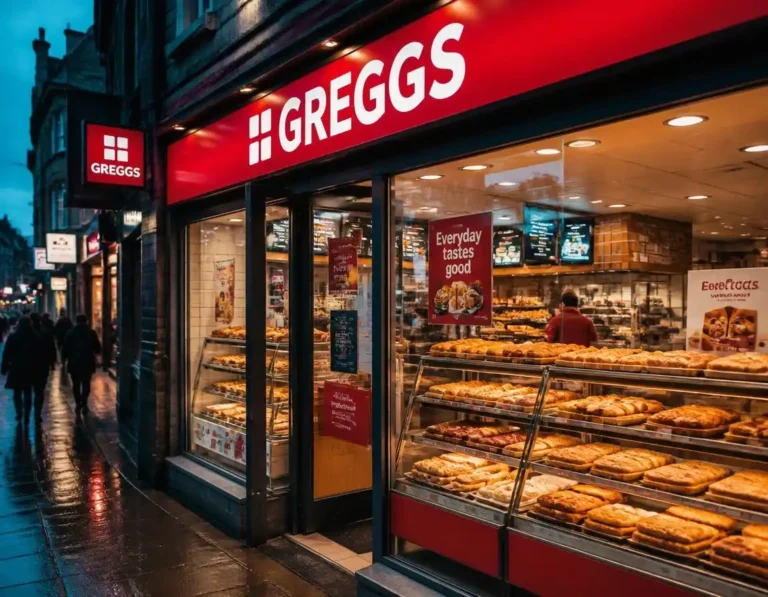
Walk into any of the nearly 2,800 UK shops and you’re standing in a working bake-off facility. Frozen product arrives, gets glazed, trayed and baked on site, then cools on open racks and sits in an open display cabinet a metre from the till. Wheat flour is in the air for hours a day. The same tongs that lift a cheese bake lift the next customer’s vegan roll. That’s the model that makes Greggs cheap and fresh — and it’s exactly why cross-contamination isn’t an edge case here, it’s the default condition.
Greggs is refreshingly honest about this in its own allergen guide: every effort is made to prevent cross-contamination, but the company cannot guarantee it hasn’t happened, and it cannot guarantee its food or hot drinks are allergen-free. Hold onto that sentence. It’s the most important line in this entire article, and it’s theirs, not mine.
⚖️What the law forces Greggs to tell you — and what it doesn’t
Two different labelling worlds exist inside the same shop, and most people never notice the seam.
Since 1 October 2021, Natasha’s Law has required full ingredient lists with emphasised allergens on prepacked-for-direct-sale food — the wrapped rolls, salads and sandwiches you grab from the shelf. The government’s own PPDS guidance for bakers spells out what those labels must carry, and Greggs reworked its packaging ahead of the deadline. For declared ingredients, the guesswork is gone.
But the hot counter is a different legal world. Loose, unwrapped food — your sausage roll, your doughnut, your slice of pizza — carries no label at all. Allergen information must be available, but in practice that lives in the in-store booklet and the QR code, not on the product. And the precautionary “may contain” warnings that do the real work of describing cross-contact risk? Entirely voluntary in UK law, with no legal thresholds and no standard wording. The FSA has consulted on tightening this; in 2026 it’s still a choice, not a duty.
| Rule | What it covers at Greggs | What it leaves out |
|---|---|---|
| Natasha’s Law (PPDS), Oct 2021 | Wrapped rolls, salads, sandwiches: full ingredients, allergens emphasised | Says nothing about cross-contact during baking or display |
| Loose-food allergen info | Counter bakes, doughnuts, pizza: info via QR code, booklet or staff | No label on the item itself; you must ask or scan mid-queue |
| “May contain” (PAL) | Voluntary warnings on packs and in the allergen guide | No legal definition, no thresholds, no consistency requirement |
| “Gluten free” claims | Must meet the 20 mg/kg standard — porridge pots, tomato soup, Caramel Crispy Bar | The claim covers the recipe, not the flour-filled shop it’s sold in |
🌀The seven cross-contact routes inside every shop
This is the bit no allergen menu explains: the physical paths allergens travel after the label is printed.
| Route | What it moves around | Can staff control it? |
|---|---|---|
| 1. Shared ovens & trays | Gluten, milk, egg, soya, sesame — everything bakes side by side | Partly: spacing and sequencing, never separation |
| 2. Airborne flour dust | Gluten, settled on every surface and product in the shop | No — it’s inherent to bake-off |
| 3. Tongs, scoops & glaze brushes | Egg wash, dairy glazes, sesame toppings between items | Partly: fresh tongs on request, if you ask |
| 4. Open display shelves | Nut and sesame crumbs drifting onto neighbouring products | No — open display is the format |
| 5. Coffee machines & steam wands | Milk and soya, all day, through shared pipes and wands | No — Greggs says drinks can’t be guaranteed allergen-free |
| 6. Greggs Express iced-drinks machines | Milk traces, by design of the machine itself | No — it’s in the official guide as a known limitation |
| 7. Peak-time hands & wrapping | Everything, when the queue is out the door | Partly: training helps, rush hour is rush hour |
“Can you use fresh tongs and take mine from a new tray?” Most teams will happily do it at 10am. At 1pm with twelve people in the queue, you’ll get an honest shrug — and that shrug is your real risk assessment.
🌱The vegan trap: “plant-based” is not “allergen-free”
This one catches people out every single week. Vegan at Greggs means no animal ingredients in the recipe — it does not mean a separate production line. The official allergen guide states plainly that the Vegan Friendly range cannot be guaranteed allergen-free, because those bakes share ovens, trays and tongs with everything else. The Vegan Society makes the same point about vegan labelling generally: cross-contamination warnings on vegan food are expected, not scandalous.
So for lactose intolerance, the Greggs vegan menu is genuinely useful — a Vegan Sausage Roll has no dairy in it. For a severe milk or egg allergy, that same roll carries a real trace risk on any given day. And don’t forget the drinks: milk alternatives have never been rolled out as a reliable, nationwide standard at Greggs — oat or soya milk turns up at some branches and not others, so it’s a “sometimes, ask in-store” option rather than a dependable one. Our dairy-free guide still lands on the same answer — black Americano or espresso, because the machines themselves can’t be guaranteed.
One more niche but real one: the vegan fills are Quorn mycoprotein, a fungal protein, and the pastry’s filling also carries rapeseed protein — which can occasionally affect people sensitive to mustard. Reactions to mycoprotein are rare but documented, and if you have a known mould or fungal sensitivity, “vegan” is not automatically “safe for you” either.
🌾The coeliac reality check
Roughly nine in ten items on the menu contain gluten as a direct ingredient — and the other tenth still shares the air.
Counting through Greggs’ own allergen guide, around 90% of the menu lists gluten-containing cereals as an ingredient; it’s a bakery, that’s the job. The officially gluten-free pocket is small: the three porridge pots, tomato soup and the Caramel Crispy Bar, plus sealed crisps, fruit pots and bottled drinks. Our gluten-free menu guide lists them all with prices and calories.
But coeliac disease isn’t an ingredient issue, it’s a trace issue — around 1 in 100 people in the UK have it, per Coeliac UK, with hundreds of thousands undiagnosed. In a shop where flour is airborne and tongs roam, “no gluten in the recipe” is not the same as safe. Greggs doesn’t claim otherwise, and neither should anyone selling you a gluten-free Greggs breakfast fantasy. Sealed, factory-packed items are the only genuinely low-risk choice here.
🚨When labelling has slipped: the incident file
None of this is hypothetical. Here’s the recent record, Greggs-specific and industry-wide.
| When | What happened | Why it matters to you |
|---|---|---|
| Jan 2025 | FSA allergy alert: Greggs 2-pack Steak Bake (280g, frozen, sold at Iceland) recalled — Sausage, Bean & Cheese Melts containing sulphites mis-packed in Steak Bake sleeves | A packaging error, not a recipe one — the label was right for a product that wasn’t in the pack |
| 2026 | Yum Yums and Hot Yum Yums gained a new “may contain” warning for gluten cereals — rye, barley, oats, spelt | An item you tolerated in 2025 may not be the item you buy in 2026 |
| Ongoing | Official guide notes Greggs Express iced-drinks machines may carry milk traces by design | A documented, permanent cross-contact point most customers never hear about |
| Context | Across the whole UK food industry, 84 allergy alerts for undeclared allergens in the 12 months to June 2026 (compiled FSA alert data) | Undeclared allergens remain the single biggest driver of UK food recalls |
Greggs keeps recipe and allergen changes flagged in a product-updates section for at least 28 days, which is genuinely helpful — if you know to look. The 2025 recall is the sharper lesson: even a perfect label fails when the wrong product goes in the pack, which is exactly why anyone with a sulphite, mustard or sesame allergy should treat frozen retail packs of any brand with the same care as fresh ones.
🚦Your personal risk ladder
My honest 1–5 rating of cross-contact risk by what you’re buying, not by what the label says.
| Your situation | Realistic risk at Greggs | Smartest order |
|---|---|---|
| Coeliac disease | High — airborne flour plus shared everything | Sealed crisps, fruit pot, bottled drink; skip the bakery entirely |
| Peanut / tree nut allergy | High — no product can be guaranteed nut-free | Sealed packs only; carry your auto-injector regardless |
| Severe milk allergy | High — glazes, shared ovens, drinks machines | Sealed packs; black coffee at best, never a milky drink |
| Egg allergy | Medium-high — egg wash glaze on most bakes | Vegan-range items plus fresh-tongs request, or sealed packs |
| Sulphite sensitivity | Medium — declared on many bakes, plus the 2025 mis-pack recall | Check the live guide the same day; avoid frozen retail packs |
| Lactose intolerance | Low-medium — traces usually tolerated | Vegan range, black coffee, porridge pots (made with water on request) |
🛡️The ordering script I actually use
1. Scan the in-store QR code before you queue — it’s the live guide, not last month’s PDF. 2. Check the product-updates list for anything you ate safely last time. 3. Say your allergy out loud at the till, even when it feels awkward. 4. Ask for fresh tongs and, if possible, a piece from a new tray. 5. For severe allergy, prefer sealed factory packs and skip the counter altogether. 6. Keep Greggs Customer Care (0808 147 3447) saved for pre-visit checks on seasonal items. If you’d rather do the filtering at home, our allergen filter tool narrows the menu to your exact profile in two clicks — with the same cross-contamination caveat baked in, because that’s the honest way to build it.
And please hear this part: none of the above makes Greggs the villain. Their allergen guide is public, detailed and unusually candid about its own limits. The nightmare isn’t the bakery — it’s the assumption that a green tick on a third-party list, or a vegan logo, or last year’s memory of an item, is the same thing as a safety guarantee. It never was.
✅ My honest verdict
- Mild intolerance or preference? Greggs is workable in 2026 — vegan range, porridge pots, soups and sealed snacks give you real choice at real prices.
- Severe allergy or coeliac disease? Treat Greggs as a sealed-packs-only stop. No label, logo or staff assurance can remove the flour cloud, and the company itself says so.
- Buying for someone else? Check the live guide on the day, not a cached page — including mine. Recipes move, and the 2026 Yum Yum change is proof that “always been fine” expires.
- One habit worth keeping forever: say the allergy out loud at the till. Every other control on this page is second-best to that one sentence.
❓Frequently asked questions
Why can’t Greggs guarantee any item is allergen-free?+
Because every shop is a working bakery. Ovens, trays, tongs and display shelves are shared across the whole menu, flour hangs in the air, and the drinks machines handle milk all day long. Greggs’ own allergen guide says it cannot guarantee its food or hot drinks are allergen-free, so “may contain” here describes the environment, not legal small print.
Does Natasha’s Law make Greggs safe for people with allergies?+
Partly. Since 1 October 2021 the law has forced full ingredient lists with emphasised allergens onto prepacked items like Greggs’ wrapped rolls and salads, which removed the guesswork around declared ingredients. It does not cover precautionary “may contain” warnings or cross-contact in store, though, so for a severe allergy the label is a starting point rather than a guarantee.
Are Greggs vegan items safe for milk or egg allergies?+
For most people managing lactose intolerance, yes — items like the Vegan Sausage Roll contain no dairy or egg as ingredients. For a severe milk or egg allergy, no: vegan bakes share ovens, trays and tongs with dairy and egg products, and Greggs states it cannot guarantee the vegan range is allergen-free, so trace contact is possible on any given day.
Key sources: Greggs official allergen guide & nutrition pages (cross-contamination statements, Express machine milk note, 28-day product updates); FSA allergy alert, Jan 2025 (Greggs 2-pack Steak Bake, undeclared sulphites) via trading standards and UK press; gov.uk PPDS / Natasha’s Law guidance for bakers (Oct 2021); FSA-linked prevalence study, ~6% of UK adults (~2.4m) with confirmed food allergy (2024); Coeliac UK prevalence figures; compiled FSA allergy-alert counts to June 2026; Vegan Society allergen-labelling guidance. Site consistency checked against our own allergen, gluten-free, dairy-free and vegan guides, September 2026.