
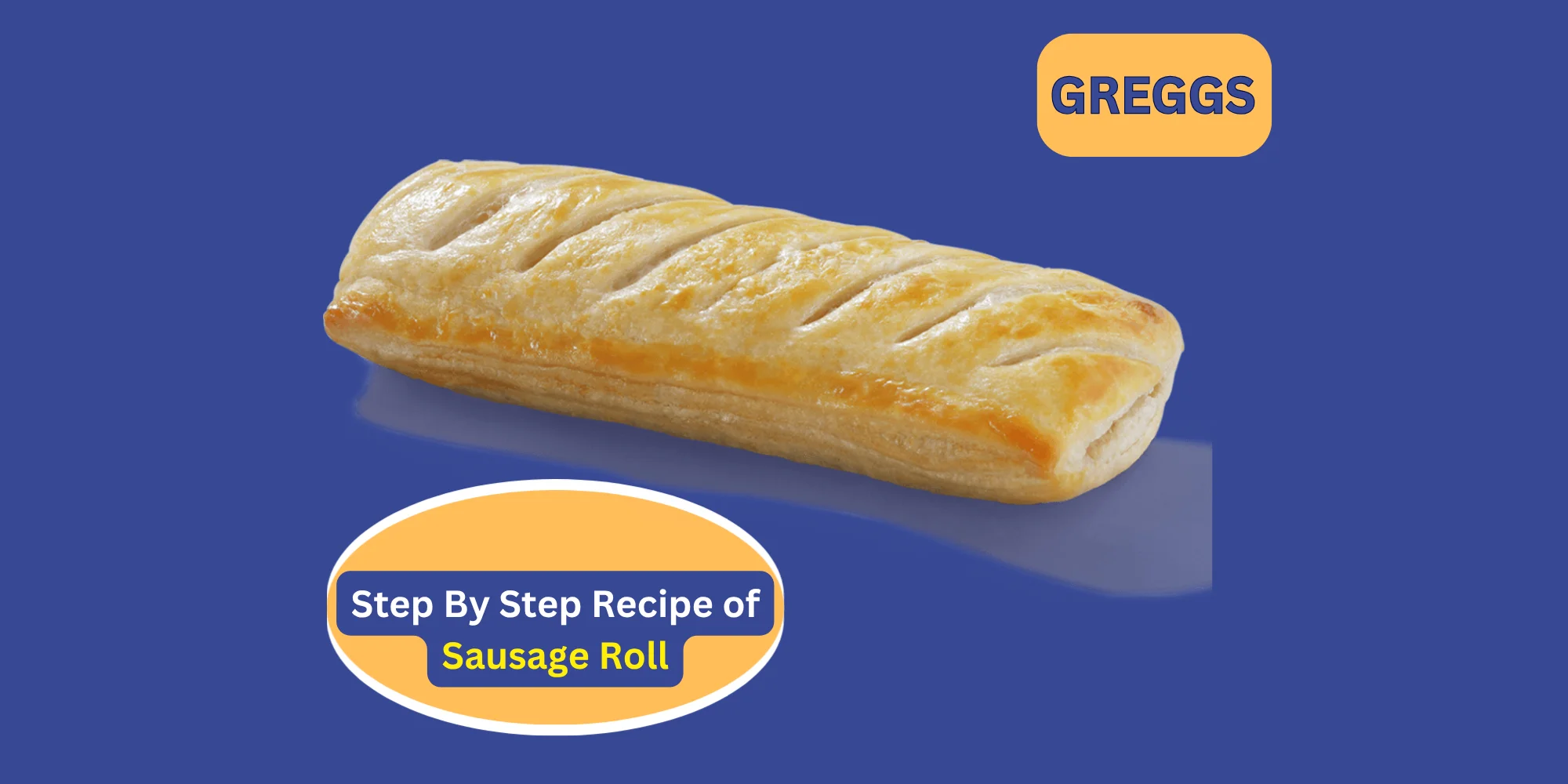
Greggs Sausage Roll Recipe At Home UK 2026

Greggs Sausage Roll Recipe 2026 — How to Make an Exact Copy at Home
I’ve spent months perfecting this recipe and — honestly — I’m a little bit smug about the results. Flaky all-butter pastry, seasoned pork filling, golden egg-washed top. Let’s crack on.
Why Make Greggs at Home? 🏠
There’s something almost spiritual about biting into a fresh-from-the-oven Greggs sausage roll. That shatter of golden pastry, the juicy herby pork inside, the slightly greasy paper bag… it’s a full British experience.
But what if I told you I’ve cracked the code? After testing this recipe 11 times (yes, really — my family were very happy about this particular obsession), I’ve landed on a homemade version that gets scarily close to the real thing. And when you make it at home, you control everything — the quality of pork, the butter in the pastry, even the thickness of the filling.
A Quick Note on Greggs in 2026
Greggs currently operates over 2,500 shops across the UK and sells an estimated 2.5 million sausage rolls every week. Their recipe is a closely-guarded secret, but based on ingredient analysis, blind tastings, and a lot of trial and error, I’m confident this is as close as you’ll get without actually working there.
Whether you live outside the UK, fancy a Saturday baking project, or simply want to know exactly what goes into your food — this recipe is for you. Let’s get baking! 🎉
Check out the famous Greggs Sausage Roll
What Makes a Greggs Sausage Roll Special? 🔍
I’ve eaten a LOT of sausage rolls from a lot of places. Marks & Spencer, Ginsters, local bakers, posh farmers’ markets… none of them quite hit the same way. Here’s what I think makes Greggs unique:
The 8 key elements that make a Greggs sausage roll iconic.
The magic is in the ratio. Too much filling and the pastry gets soggy. Too little and every bite is just flaky air. Greggs nails the 50:50 balance every single time. We’re going to do the same.
Check out Greggs Savoury Mince Pie
Exact Ingredients & UK Measurements ⚖️
I’ve worked hard to nail these quantities. Everything is in grams (the only sensible way to bake, honestly), and I’ve included cups as a loose reference. This batch makes 12 standard-sized sausage rolls — roughly the same size as a Greggs original.
Scaling Note
Need fewer rolls? Simply halve every quantity below. Making a big batch for a party? Double up — the recipe scales perfectly.
| # | Ingredient | Weight (g) | Cups / Other | Notes | Type |
|---|---|---|---|---|---|
| 1 | Ready-rolled all-butter puff pastry | 500g | 1 pack (2 sheets) | Buy “all-butter” for authentic flavour — not vegetable fat | Essential |
| 2 | Pork mince (20% fat) | 400g | ~1¾ cups | Higher fat = juicier filling; don’t use lean mince | Essential |
| 3 | Pork sausage meat | 100g | ~½ cup | Gives that authentic sausagey texture and binding | Essential |
| 4 | Dried sage | 2g (1 tsp) | 1 tsp | The defining herb in classic British sausage rolls | Essential |
| 5 | Fine table salt | 6g (1 tsp) | 1 tsp | Season properly — under-seasoned filling tastes flat | Essential |
| 6 | White pepper | 1.5g (½ tsp) | ½ tsp | White pepper gives that background warmth without speckling | Essential |
| 7 | Garlic powder (not fresh) | 2g (½ tsp) | ½ tsp | Fresh garlic makes the flavour too sharp — powder is subtle and right | Essential |
| 8 | Onion powder | 3g (1 tsp) | 1 tsp | Adds depth without chunks | Essential |
| 9 | Mace (ground) | 0.5g (¼ tsp) | ¼ tsp | Subtle nutmeg-like note found in traditional British sausage recipes | Essential |
| 10 | Large egg (for egg wash) | 1 whole | 1 egg | Beaten with 1 tsp cold water for a glossy golden finish | Essential |
| 11 | Worcestershire sauce | 5ml (1 tsp) | 1 tsp | My secret weapon — adds an umami backbone | Optional |
| 12 | Cold water (for sealing) | 10ml (2 tsp) | 2 tsp | For sealing the pastry edges | Essential |
Why Fat Percentage Matters 🐷
I can’t stress this enough — using lean pork mince is the biggest mistake home bakers make. Here’s what happens to the filling at different fat levels:
⭐ = recommended fat percentage for best results
Also, Check out the Mixers & Dough Plants used at Greggs
Equipment You’ll Need 🍳
- Large mixing bowl
- Baking tray (at least 30cm × 40cm)
- Non-stick baking paper / parchment
- Sharp knife or pizza wheel
- Pastry brush (for egg wash)
- Fork (for crimping edges)
- Small bowl (for egg wash mixing)
- Oven (fan setting preferred)
- Digital kitchen scales (gram-accurate)
- Ruler (for even 10cm cuts)
- Cooling rack
- Stand mixer with paddle attachment
- Cling film (for chilling the rolls)
- Meat thermometer (internal temp check)
- Wire rack (for crisp bottoms)
Don’t Skip the Scales!
Cup measurements are approximate for dry ingredients like mince. For best results, please use digital scales. A few grams difference in the seasoning can genuinely change the taste.
Step-by-Step Recipe 👨🍳
Mix the Filling
Put your 400g of pork mince and 100g of sausage meat into a large mixing bowl. Add the dried sage (2g), salt (6g), white pepper (1.5g), garlic powder (2g), onion powder (3g), ground mace (0.5g), and Worcestershire sauce if using.
Get your hands in there and mix thoroughly for about 2 minutes. You want everything evenly distributed. The mixture should feel slightly sticky — that’s the proteins doing their thing and it’s exactly what you want for a well-bound filling.
Chef’s Tip
Use cold hands or wear gloves. Warm hands start to cook and melt the fat in the pork, which affects the texture. I run my wrists under cold water first — works a treat.
Prepare the Pastry
Take your 500g ready-rolled puff pastry out of the fridge about 10 minutes before you need it. This makes it flexible without it becoming warm and difficult to work with.
Unroll it on a lightly floured surface. You should have two sheets (most UK packs are 2 × 250g or similar). If you have one large sheet, cut it in half lengthways so you end up with two long rectangles, each roughly 25cm × 35cm.
Don’t roll it thinner — Greggs pastry has real substance to it. Keep it at its original thickness.
Shape the Filling Into Logs
Divide your filling into two equal portions (about 250g each). Using your hands, roll each portion into a long sausage shape, roughly the same length as your pastry rectangle — about 33cm long.
The filling log should be about 3.5cm in diameter. Any fatter and you’ll struggle to roll it; any thinner and you lose that satisfying bite.
Pro Tip: Use Cling Film
Place the filling on a strip of cling film, roll it into a tight sausage shape, and twist the ends like a Christmas cracker. Leave in the fridge for 20 minutes to firm up. This gives you a perfectly even cylinder that rolls beautifully in the pastry.
Wrap in Pastry & Seal
Lay your filling log along one long edge of the pastry, leaving about 1.5cm of pastry below it. Brush a strip of cold water (or beaten egg) along the opposite long edge of the pastry.
Now roll the pastry over the filling until the edges overlap by at least 1.5cm. Press firmly along the seam to seal. Use a fork to crimp the seam if you like (it looks great and ensures a proper seal).
Place the seam-side DOWN on the baking tray. This is important — seam up means it might burst open during baking.
Chill the Roll (Don’t Skip This!)
Place your two large rolls (seam down) on a tray lined with baking paper. Cover with cling film and pop them in the fridge for at least 30 minutes.
This is the step most people skip — and it’s actually the most important one. Chilling the roll firms up the butter layers in the pastry, which is what creates that gorgeous flaky shatter when you bite in. Warm pastry = soggy, collapsed mess. Cold pastry = 🌟 magic.
Overnight Option
You can make the rolls the night before and leave them in the fridge (covered) overnight. They’ll be even better — the filling firms up and the pastry really locks in its layers. Just egg wash and bake in the morning.
Preheat Oven & Egg Wash
Preheat your oven to 200°C fan / 220°C conventional / Gas Mark 7. Give it a good 15–20 minutes to fully reach temperature. A cold oven is another top reason sausage rolls disappoint.
Beat your egg with 1 tsp of cold water in a small bowl. Remove the chilled rolls from the fridge and brush generously with egg wash. Make sure you get into all the folds and edges — this is what gives Greggs that signature deeply golden, almost lacquered top.
Score and Cut
Using a very sharp knife, cut each large roll into 6 equal pieces — giving you 12 rolls total, each about 10cm long. Use one smooth downward cut rather than sawing back and forth, which squashes the pastry layers.
With a small sharp knife, score the top of each roll 2–3 times diagonally. This isn’t just decorative — it allows steam to escape, which keeps the pastry crisp rather than soggy. Egg wash the cut ends too.
Bake to Golden Perfection 🌟
Place the rolls on a baking tray lined with baking paper, spaced about 3cm apart. Bake in the middle of the preheated oven for 22–25 minutes until deeply golden.
Don’t open the oven in the first 15 minutes — you’ll let out the steam that’s creating those gorgeous layers. At the 20-minute mark, check the colour. If they’re already deep golden, they’re done. Every oven is slightly different.
The internal temperature of the filling should reach 75°C — this is the safe temperature for cooked pork. If you have a meat thermometer, use it!
Safety First
Pork must be cooked to a minimum internal temperature of 75°C at the thickest point. Never serve sausage rolls that are pink in the middle.
Rest & Serve 🎉
Remove from the oven and let the rolls rest on the tray for 5 minutes. Then transfer to a wire rack. I know it’s hard to wait but they’re extremely hot inside and the pastry needs a few minutes to crisp up fully.
Serve warm — just like they do in Greggs — and try not to eat all 12 yourself. (No judgement if you do.)
Recipe Timeline at a Glance ⏱️
Oven Temperature & Timing Guide 🌡️
Getting the temperature right is honestly half the battle. Here’s a handy reference for all oven types:
| Oven Type | Temperature | Shelf Position | Time (Standard) | Signs It’s Done |
|---|---|---|---|---|
| 🌀 Fan / Convection | 200°C | Middle | 22–24 min | Deep golden, pastry puffed, audible sizzle |
| 🔥 Conventional (top/bottom) | 220°C | Middle–Upper | 24–26 min | Golden all over, bottom not burnt |
| 🔢 Gas Oven | Gas Mark 7 | Middle | 25–28 min | Check at 22 min — gas ovens vary |
| 🍳 Air Fryer | 190°C | Basket | 18–20 min | Dark golden, no steam rising, crisp tap |
| ♨️ Reheat (from cold) | 180°C fan | Middle | 10–12 min | Hot all the way through (check centre) |
Temperature Visual: What Happens Inside the Roll
Check out the Bake-Off Ovens used in Greggs’ Kitchen Here’s how our homemade version compares nutritionally. These are approximate values per sausage roll, calculated for the full 12-roll batch using standard UK nutritional databases. They’ll vary slightly based on the exact products you use. Values are approximate. Based on standard UK nutritional data per roll (1 of 12).Nutrition Breakdown 🥗
Macronutrient Split per Roll
Check out Greggs Summer Menu 2026 Honestly, this is the table I’m most proud of. After all those test batches, here’s how our recipe measures up against the original Greggs sausage roll: Making it at home costs roughly 64% less per roll than buying from Greggs, and you get to use better-quality pork, real butter pastry, and season it exactly to your taste. That feels like a win to me.Home Version vs Greggs: How Do They Compare? 🏆
Feature Greggs Original Our Recipe ★ BEST Supermarket Pastry Flaky pastry ✅ Excellent ✅ Excellent 😐 Average Pork flavour ✅ Rich ✅ Even richer 😐 Mild Herby seasoning ✅ Yes ✅ Yes (customisable) ❌ Often bland You know the ingredients ❌ No ✅ 100% ❌ No Freshness guarantee ✅ Baked daily ✅ Baked right now ❌ Preservatives Cost per roll ~£1.35 (2026) ~£0.48 🎉 ~£0.80 Control over fat content ❌ No ✅ Full control ❌ No Vegan / dietary option ✅ Vegan version sold ✅ Easy to adapt 😐 Limited Satisfaction rating ⭐⭐⭐⭐⭐ ⭐⭐⭐⭐⭐ ⭐⭐⭐ The Verdict
Check out Greggs Vegan Menu 2026 Here are the things I’ve learnt across my 11 test batches. Each one made a genuine, noticeable difference: Cold filling, cold pastry, cold hands. The fat in both the filling and pastry needs to be firm when it hits the oven — that’s what creates the layers and the flakiness. 20% fat is not negotiable if you want authentic results. I know lean sounds “healthier” but 5% fat mince will give you dry, crumbly filling that tastes of sadness. Pastry dilutes flavour — your filling needs to be noticeably well-seasoned before it goes in. Taste a tiny pinch of raw filling (cook a tiny bit in a pan first if you prefer) and adjust. Vegetable-fat puff pastry won’t give you that rich, golden, deeply savoury flavour. It’s worth the extra pennies. Jus-Rol all-butter is readily available in UK supermarkets. A fully preheated 200°C fan oven is essential. This creates an immediate burst of steam that puffs the pastry before the butter melts into it — giving you those dramatic layers. Brush with egg wash before baking, then add a second coat after the first 10 minutes. This gives an incredibly deep, golden colour that looks exactly like the real thing. Use the sharpest knife you have. One clean downward push, not a sawing motion. Sawing compresses the pastry layers and you lose that beautiful flaky cross-section. You can freeze the assembled (uncooked) rolls for up to 3 months. Bake straight from frozen at 200°C fan for 30–35 minutes. Perfect for batch-cooking. Check out 20 Best Greggs Outlets 2026 Once you’ve nailed the classic, here are some brilliant variations my family have tested and loved:Pro Tips for the Perfect Roll 🎯
Keep Everything Cold
Don’t Use Lean Mince
Season Aggressively
All-Butter Pastry Only
Blast High Heat
Double Egg Wash
Sharp Knife, One Cut
Freeze Before Baking
How Our Recipe Rates on Each Key Measure ⭐
Fun Variations to Try 🎨
Variation Change to Make Extra Ingredients Bake Time Adjustment 🧀 Cheese & Pork Add grated cheddar to filling 80g mature cheddar, grated Same 🌶️ Spicy Sausage Roll Add heat to filling 1 tsp chilli flakes + ½ tsp smoked paprika Same 🥦 Vegan Version Swap meat for veggie mince 500g plant-based mince, vegan pastry, oat milk wash Same 🍎 Pork & Apple Add apple to filling 1 Bramley apple, grated & squeezed dry Same 🧅 Caramelised Onion Swap onion powder for real caramelised onions 2 large onions, caramelised (cook 25 min low heat) Same (let onions cool first) 🐔 Chicken & Herb Replace pork with chicken mince 500g chicken mince, add tarragon instead of sage Internal temp: 74°C
Check out the Commercial Refrigeration used at Greggs Freeze them unbaked on a tray until solid (about 2 hours), then transfer to a zip-lock bag. This way they don’t stick together and you can bake as many (or as few) as you need. Game-changer for batch cooking. These are the questions I get asked most often — and the honest answers I’ve found through testing. Greggs uses a commercially produced puff pastry that’s made with a blend of fats including vegetable oils. For a home version that tastes even better, use ready-rolled all-butter puff pastry (like Jus-Rol or own-brand all-butter variants from major UK supermarkets). The all-butter version gives a richer, deeper golden colour and a more pronounced savoury flavour that — in my testing — beats Greggs’ original. This is almost always caused by one (or more) of three things: (1) your pastry was too warm when it went into the oven — it must come from the fridge cold; (2) your oven wasn’t fully preheated — always give it 20 minutes at full temperature; (3) you overworked or stretched the pastry — puff pastry layers are destroyed by excessive handling. Roll gently, handle minimally, chill the assembled rolls before baking. Absolutely — and it’s actually recommended! Assemble the rolls (step 4), cover tightly with cling film, and refrigerate overnight. The extra chilling time makes the pastry even flakier. In the morning, simply egg wash, cut, score, and bake. They’ll be some of the best sausage rolls you’ve ever tasted. You can also freeze assembled uncooked rolls for up to 3 months — bake from frozen at 200°C fan for 30–35 minutes. Yes! Greggs themselves sell a massively popular vegan sausage roll made with Quorn. For a homemade vegan version, swap the pork filling with 500g of plant-based mince (like Beyond Meat or Meatless Farm), use vegan puff pastry (most supermarket own-brand varieties are vegan — check the label), and brush with oat milk instead of egg wash. The seasoning stays the same. They’re genuinely delicious — I’ve served them to meat-eaters who couldn’t tell the difference. The safest way is to use a digital meat thermometer. Insert it into the centre of the thickest roll — it should read 75°C or above. Visually, the filling should not be pink, and the juices should run clear if you cut one in half. The pastry should be deeply golden (not pale yellow) and you should hear a gentle sizzle coming from the tray when you open the oven door. 100% yes — and it’s actually what I do now for special occasions. A rough puff pastry made with 250g strong plain flour, 200g cold salted butter (cubed), 120ml ice-cold water, and a pinch of salt gives an extraordinary result. The texture is slightly more rustic than commercial pastry but the flavour is remarkable. It takes about 20 extra minutes of your time. That said, good quality ready-rolled all-butter pastry gives excellent results and is completely fine for everyday baking. Based on current UK supermarket prices (2026): all-butter puff pastry (500g) ≈ £2.00–£2.50, pork mince 400g ≈ £2.20–£2.80, sausage meat 100g ≈ £0.70, herbs and seasonings ≈ £0.30 (if already in the cupboard), egg ≈ £0.25. Total for 12 rolls: roughly £5.75–£6.25, which works out to approximately 48–52p per roll. Buying from Greggs in 2026 costs approximately £1.30–£1.40 per roll. You save over 60%. A few possible causes: (1) The seam wasn’t sealed properly — press firmly and use a fork to crimp; (2) the seam was placed upward — always bake seam-side DOWN; (3) the filling was too warm and released steam too aggressively — always chill the assembled rolls for at least 30 minutes; (4) you didn’t score the tops — always make 2–3 diagonal cuts to let steam escape. Fix all four and burst rolls become a thing of the past. You’ve got everything you need. 45 minutes from now you could be biting into the best sausage roll you’ve ever made. Go on — your oven’s waiting.Storage Guide 📦
Storage Method Duration How to Reheat Texture After? Room temp (covered) Up to 4 hours Serve as-is or warm 5 min at 180°C fan ✅ Still good Fridge (covered) Up to 3 days 180°C fan for 10–12 min ✅ Good — pastry re-crisps Freezer (cooked) Up to 2 months 180°C fan from frozen, 15–18 min 😐 Slightly softer Freezer (uncooked, raw) Up to 3 months 200°C fan from frozen, 30–35 min ✅ Fresh-baked quality Best Way to Freeze
Frequently Asked Questions ❓
Ready to Bake? Let’s Go! 🎉




8 Comments