Is Greggs Healthy?

Is Greggs Healthy? 2026 Calories, Salt & Sugar Checked
Updated September 2026 · Figures taken from Greggs’ own product pages
The short version
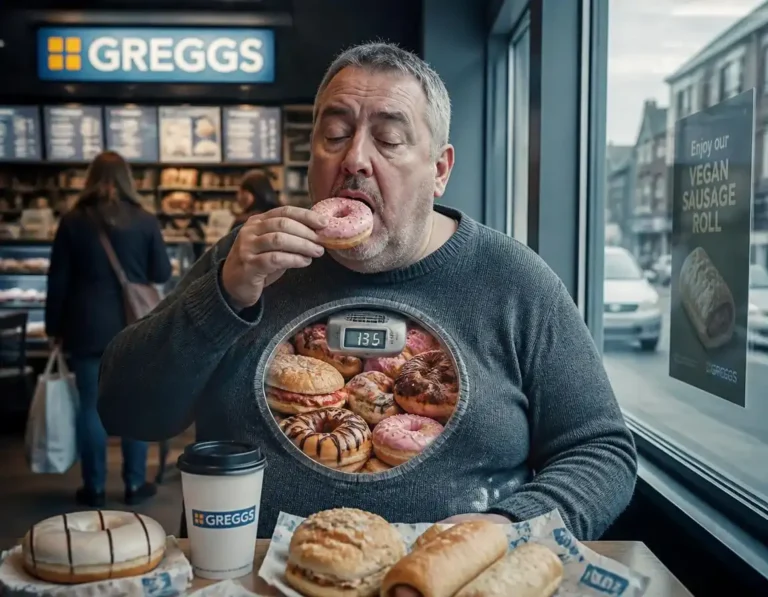
Greggs isn’t a health-food brand, and the 2026 menu doesn’t pretend otherwise. A sausage roll is 348 kcal with 11g of saturated fat and 1.6g of salt, and a Sausage Breakfast Baguette reaches 543 kcal and 2.6g of salt. But the chiller and the coffee machine tell a different story: a 43 kcal fruit pot, a 127 kcal egg pot with 12g of protein, a 339 kcal prawn pasta salad, and a green Balanced Choice logo on anything under 400 kcal with no red traffic lights. Verdict: fine now and then, a poor daily habit if pastry is your default order.
Is Greggs healthy? The short answer, properly
“Is Greggs healthy?” is the wrong question on its own. The better one is: healthy compared to what, and how often? A bakery counter built around pastry was never going to beat a salad bar on nutrients per pound. But next to most UK takeaway lunches, the 2026 Greggs menu is easier to navigate than its reputation suggests, as long as you know which shelves to trust. Every figure in this article comes from Greggs’ own product pages, checked in September 2026.
Three things decide whether a visit helps or hurts your week. The first is what you pick: a 43 kcal fruit pot against a 543 kcal Sausage Breakfast Baguette is a gap of more than twelve times. The second is what you drink: a regular caramel latte carries 24g of sugars, a regular Americano carries none. The third is how often you go. Once a week is a treat, once a day is a diet. The rest of this article is the evidence.
Greggs calories and nutrition: the classics by the numbers
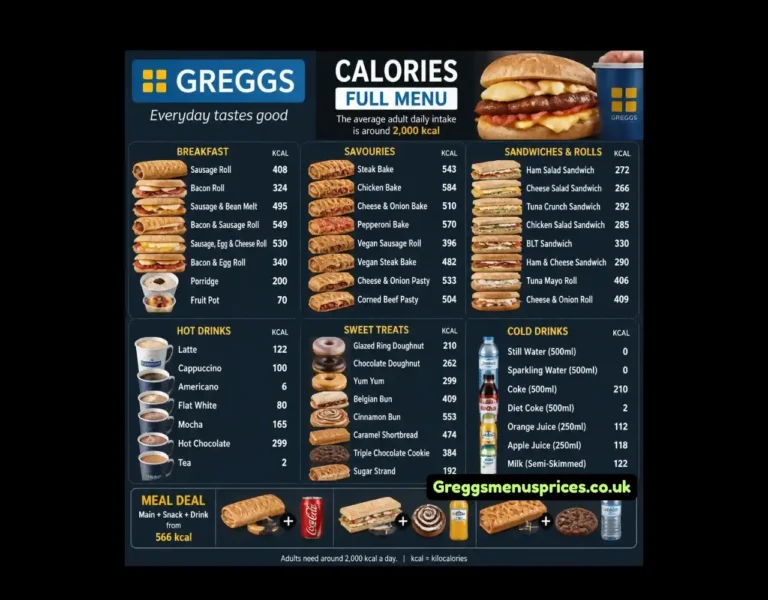
Start where everyone starts, at the counter. These are Greggs’ published per-portion figures for the items people actually buy, and they explain both the love and the concern in one table. Our full calorie guide and nutrition and allergen tables cover everything else on the menu.
| Item (per portion) | Calories | Sat fat | Salt | Sugars | The honest read |
|---|---|---|---|---|---|
| Sausage Roll (103g) | 348 | 11g | 1.6g | 0g | 24g fat, 55% of the saturated-fat reference intake and over a quarter of your salt limit |
| Vegan Sausage Roll, hot (101g) | 308 | 9.3g | 1.8g | 0.7g | Less fat and more protein (11g) than the pork roll, but saltier |
| Steak Bake (136g) | 409 | 13g | 1.4g | 0g | A meal’s worth of calories in a snack, with 64% of the saturated-fat reference intake |
| Chicken Bake (150g) | 424 | 14g | 1.8g | 1.3g | 70% of the saturated-fat reference intake and 30% of your salt limit |
| Sausage Breakfast Roll (154g) | 383 | 5g | 1.8g | 5.9g | 31% of your salt limit before lunch |
| Bacon Breakfast Roll (119.5g) | 321 | 4.3g | 1.9g | 5.3g | 19g protein, but 32% of your salt limit |
| Bacon & Sausage Breakfast Roll (157g) | 405 | 6g | 2.4g | 5.7g | 40% of your daily salt limit in one roll |
| Sausage Breakfast Baguette (217g) | 543 | 6.5g | 2.6g | 3.7g | A full lunch’s calories at breakfast, and 43% of your salt limit |
| Tomato Soup (300g) | 195 | 1.5g | 1.4g | 22g | Light on calories, heavy on sugars (24% of the reference intake) |
| Prawn Layered Pasta Salad (290g) | 339 | 1.5g | 1.0g | 7.8g | 12g protein for 339 kcal, see our prawn salad guide |
| Free Range Egg Pot (90g) | 127 | 2.6g | 0.18g | 0g | 12g protein and almost no salt |
| Apple & Strawberry Fruit Pot (90g) | 43 | 0g | 0g | 8.7g | Naturally occurring sugars, counts towards your five a day |
Check the label in your shop. Greggs updates its nutrition data as recipes change, so you will see slightly different figures on other sites. The sausage roll alone has appeared as 329, 347 and 348 kcal on different Greggs pages. This table uses the most recent page we found for each item.
Calories per portion from Greggs’ product pages. Green is 200 kcal or under, amber 200 to 400, red above 400. These colour bands are ours, not Greggs’ traffic lights.
Look at the spread. The trouble with Greggs has never been that everything is heavy. It’s that the heaviest items are the most famous ones, and they sit at eye level. Walk to the chiller and the coffee machine and the ladder looks very different.
Salt at Greggs: the quiet problem
Calories get the attention, but salt is where Greggs stacks up quickly. NHS advice is that adults should have no more than 6g of salt a day, and a single Bacon & Sausage Breakfast Roll has 2.4g of it. Line up the regulars and the pattern is easy to see:
Salt per portion against the 6g daily limit. The breakfast board is the real offender, not the pastry counter.
The arithmetic gets uncomfortable fast. A bacon breakfast roll (1.9g), a sausage roll (1.6g) and a chicken bake (1.8g) come to 5.3g, which is 88% of the limit before dinner. None of it tastes especially salty, and that is the trap. One assumption is worth correcting: the vegan sausage roll is not the low-salt option. It has 1.8g against 1.6g in the pork roll. If salt is your number, the breakfast baguette and the double-meat rolls are the first things to swap, not the bakes.
Sugar at Greggs: where it hides
The sweet counter is obvious. A Yum Yum is 310 kcal with 17g of fat and 16g of sugars, and nobody is fooled. The interesting sugar figures are elsewhere:
- The coffee machine. A regular caramel or vanilla latte has about 24g of sugars (27% of the reference intake) and 204 kcal. A regular Americano has 9 kcal and no sugars. A plain milky coffee sits in between, since its sugars are mostly lactose from the milk.
- The soup. Tomato Soup carries 22g of sugars per 300g pot, which is 24% of the reference intake, in something that tastes savoury. It is honestly labelled, but it is not a salad.
- The fruit pots. The apple & strawberry pot has 8.7g and the melon & grape pot 11g. Both are naturally occurring sugars, and Greggs counts each pot as one of your five a day.
💡 Two sugar limits, not one. The percentages on Greggs’ pages use a 90g daily reference intake for total sugars, which includes sugars from fruit and milk. The NHS advises adults to have no more than 30g of free sugars a day (added sugars, honey, syrups and juices), which is a tighter target.
None of this is hidden. In England, since 6 April 2022, larger food businesses (250 or more employees) have had to display calories on menus and labels under the government’s out-of-home calorie labelling rules, and Greggs publishes full nutrition tables for every product on its website. The information is there. This section is just reading it aloud.
The healthiest things at Greggs in 2026
Most “is Greggs healthy?” articles skip this part, but there are more genuinely good options than the brand’s reputation suggests:
- Fruit pots (43 to 48 kcal): the lightest foods on the menu, with no fat, naturally occurring sugars and one of your five a day.
- Free Range Egg Pot (127 kcal, 12g protein): only 1.3g carbs and 0.18g salt. It is the best protein for the calories Greggs sells, and the hero of our keto guide for good reason.
- Tomato Soup (195 kcal): a hot lunch under 200 kcal, with the sugar caveat above. It is a seasonal item, so check your shop.
- Prawn Layered Pasta Salad (339 kcal, 12g protein, 1.0g salt): part of the 2026 summer range. Our summer menu guide, salad menu guide and sandwiches and salads guide cover the rest of the chiller.
- Simply Creamy Porridge (about 210 to 250 kcal): Greggs’ latest page shows 249 kcal, 6.6g sugars and just 0.11g salt, and describes it as gluten-free. If you have coeliac disease, read the allergen guide first, because shared kitchens carry cross-contact risk.
- Regular Americano (9 kcal): the easiest calorie saving on the whole menu.
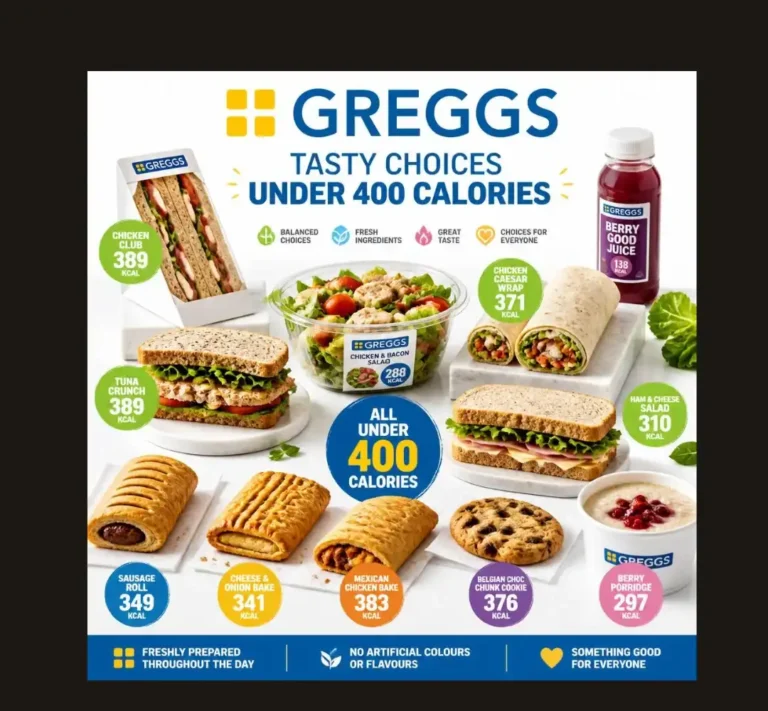
There is also a shortcut. The green Balanced Choice logo, which Greggs has used since 2016, means under 400 kcal and no reds on the nutrition traffic light label. If you only remember one rule from this article, make it that one. Our under-400-calories guide lists the qualifying items.
What Greggs is doing about healthiness
Greggs has form here, some of it awkward. It launched Balanced Choice in 2016 and in 2017 published its own “Minimise Me” 30-day plan, written by an independent dietitian around the Balanced Choice range with the odd sausage roll allowed. Dietitians gave it mixed reviews, but it did make the point that you can eat at Greggs on a plan.
The current effort is quieter. In April 2026 Greggs published its 2025 sustainability report, which says over 30% of its existing items and 40% of its new products count as healthier choices, by Greggs’ own definition. It also announced a partnership with the innovation foundation Nesta to develop a method for measuring the healthiness of its food sales, with a commitment to report against it and set a target for improvement by the end of 2030. That is a scoreboard, not a salad launch. Whether the score moves is a question for 2030, but a chain that has to report a number has a reason to reformulate. Newer items such as the Prawn Layered Pasta Salad also carry a “source of protein” flag on Greggs’ product pages.
💡 Why this matters to you: recipes change quietly. If a favourite gets reformulated, the label in your shop and Greggs’ current product page are the final word, not any article, including this one.
Greggs on a diet plan: Slimming World, calorie counting and keto
Slimming World: using the community’s rough rule of 20 kcal per Syn, a sausage roll (348 kcal) lands near 17 Syns and a steak bake (409 kcal) near 20, which is most of a day’s allowance in one item. The egg pot (about 6 Syns) and fruit pots (about 2) are the lower-Syn swaps. These are estimates only, and the Slimming World app is always final.
WW and calorie counting: log from the label, not from memory. At 348 kcal a sausage roll fits a 1,500 to 2,000 kcal day more easily than people fear. It is the second bake and the flavoured latte (204 kcal) that break the budget.
Keto: the hard one. Pastry is flour, so carbs start at 24g for a sausage roll and climb to around 30g for a steak bake or chicken bake. The egg pot (1.3g carbs) and a black coffee are your friends, and anything baked is lazy keto at best. The full carb maths lives in our Keto Greggs Guide.
Build a healthier Greggs lunch: three orders I’d place
| Combo | What’s in it | Total calories | Total salt |
|---|---|---|---|
| The light hot lunch | Tomato Soup + Melon & Grape Fruit Pot | 243 kcal | 1.4g |
| The protein pot | Prawn Layered Pasta Salad + Free Range Egg Pot | 466 kcal, about 24g protein | 1.2g |
| The classic, kept honest | Tomato Soup + one Sausage Roll, water to drink | 543 kcal | 3.0g |
Prices differ across the Standard, City/London and Franchise/Airport tiers, so price your own version with our price finder before you order. Three habits do more than any swap. Drink from the chiller or the black-coffee end of the machine (a regular caramel latte to a regular Americano saves about 195 kcal and 24g of sugars). Halve the bake and box the rest. And treat the bigger breakfast items as the salt bombs they are: porridge or an egg pot instead changes your whole day’s sodium. Our hot food guide has the calories for everything served warm.
The verdict: is Greggs healthy?
No, not as a brand, and not if your default order is two bakes and a flavoured latte. That habit comes to over 1,000 kcal, more than half your daily salt limit and about 32g of saturated fat against a 20g reference intake. The counter food is high in fat and salt by design, and the sweet counter is a sugar cabinet with a loyalty card.
But Greggs in 2026 is also a 43 kcal fruit pot, a 127 kcal egg pot, a 195 kcal soup in the colder months, a 339 kcal prawn pasta salad and a green logo that means under 400 kcal with no red traffic lights. Eaten once or twice a week with those picks in mind, Greggs fits a balanced diet. Eaten daily off the pastry shelf, almost nothing would. The difference was never the brand. It’s the order, and with calorie labelling in England since April 2022 and full nutrition tables online, you can see exactly what’s in it. This is general information, not medical advice. If you have a health condition, an allergy or a specific target, check Greggs’ allergen guide and speak to a GP or registered dietitian.
FAQs
What’s the healthiest thing to buy at Greggs in 2026?
The lightest picks are the Apple & Strawberry Fruit Pot (43 kcal), the Melon & Grape Fruit Pot (48 kcal) and a regular Americano (9 kcal). For a proper meal, the Free Range Egg Pot (127 kcal, 12g protein), the Tomato Soup (195 kcal, but seasonal and with 22g of sugars) and the Prawn Layered Pasta Salad (339 kcal, 12g protein) are the strongest options. Anything with the green Balanced Choice logo is under 400 kcal with no red traffic lights.
Is the Greggs vegan sausage roll healthier than the original?
Partly. The hot Vegan Sausage Roll is 308 kcal against 348 kcal for the pork roll, with 19g of fat against 24g, less saturated fat (9.3g against 11g) and more protein (11g against 9.2g). It is saltier though, with 1.8g against 1.6g, so it is a swap for calories and fat, not for salt. It is still pastry, so treat it as a treat, not a health food.
Can I eat Greggs and still lose weight?
Yes, if frequency and drinks behave. A sausage roll’s 348 kcal fits a 1,500–2,000 kcal day, but a daily steak bake, chicken bake and flavoured latte comes to over 1,000 kcal and more than a day’s saturated-fat reference intake. Build lunches under 400 kcal from the chiller, egg pot and salads, drink black coffee or water, and keep pastry to a couple of times a week. If you have a medical condition or a specific target, speak to a GP or registered dietitian.
Sources checked September 2026: nutrition figures from Greggs’ own product pages on greggs.com (per-portion values, allergens and Balanced Choice wording); coverage of Greggs’ 2025 sustainability report and Nesta partnership (April 2026); NHS guidance on salt and sugar; gov.uk calorie-labelling guidance. Greggs revises its figures as recipes change, so where pages differ this article uses the most recent version we found.